History
A native of South America, the water hyacinth (Eichhornia crassipes) was introduced to North America in 1884 at the New Orleans World’s Industrial and Cotton Centennial Exposition of 1884-1885. Having an attractive flower the water hyacinth plants were given away as sort of a “door prize” at the Exposition. The plant was thought to have been brought to Florida by an attendee of the Exposition in 1890. The water hyacinth has since become one of the worst aquatic weed species to plague the state and at times covering well over 100,000 acres of waterways in Florida. Additional information on the life history of water hyacinth can be viewed at
http://www.sms.si.edu/irlspec/eichhornia_crassipes.htm.
The following picture shows how bad was the Hyacinth on one of the Florida rivers
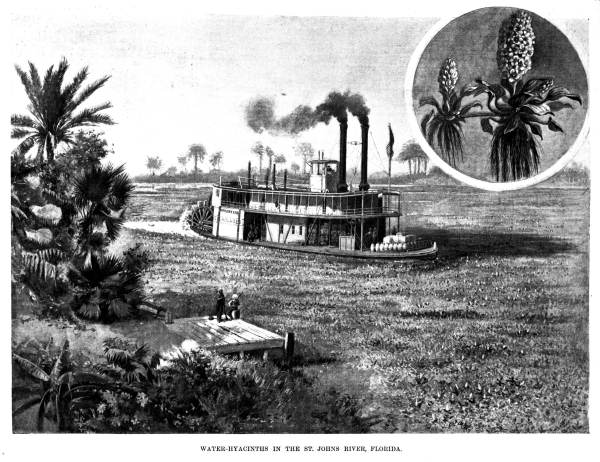
By 1917 parts of the Caloosahatchee River were infested with dense mats of water hyacinth.
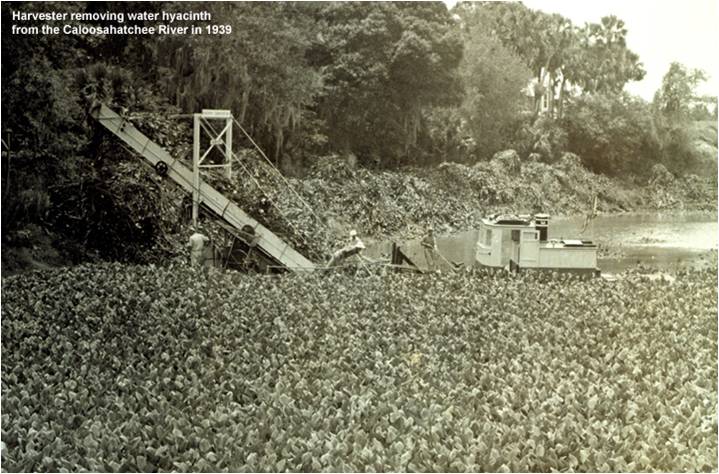
The picture below shows water hyacinths being excavated from a Caloosahatchee River oxbow in 1939.
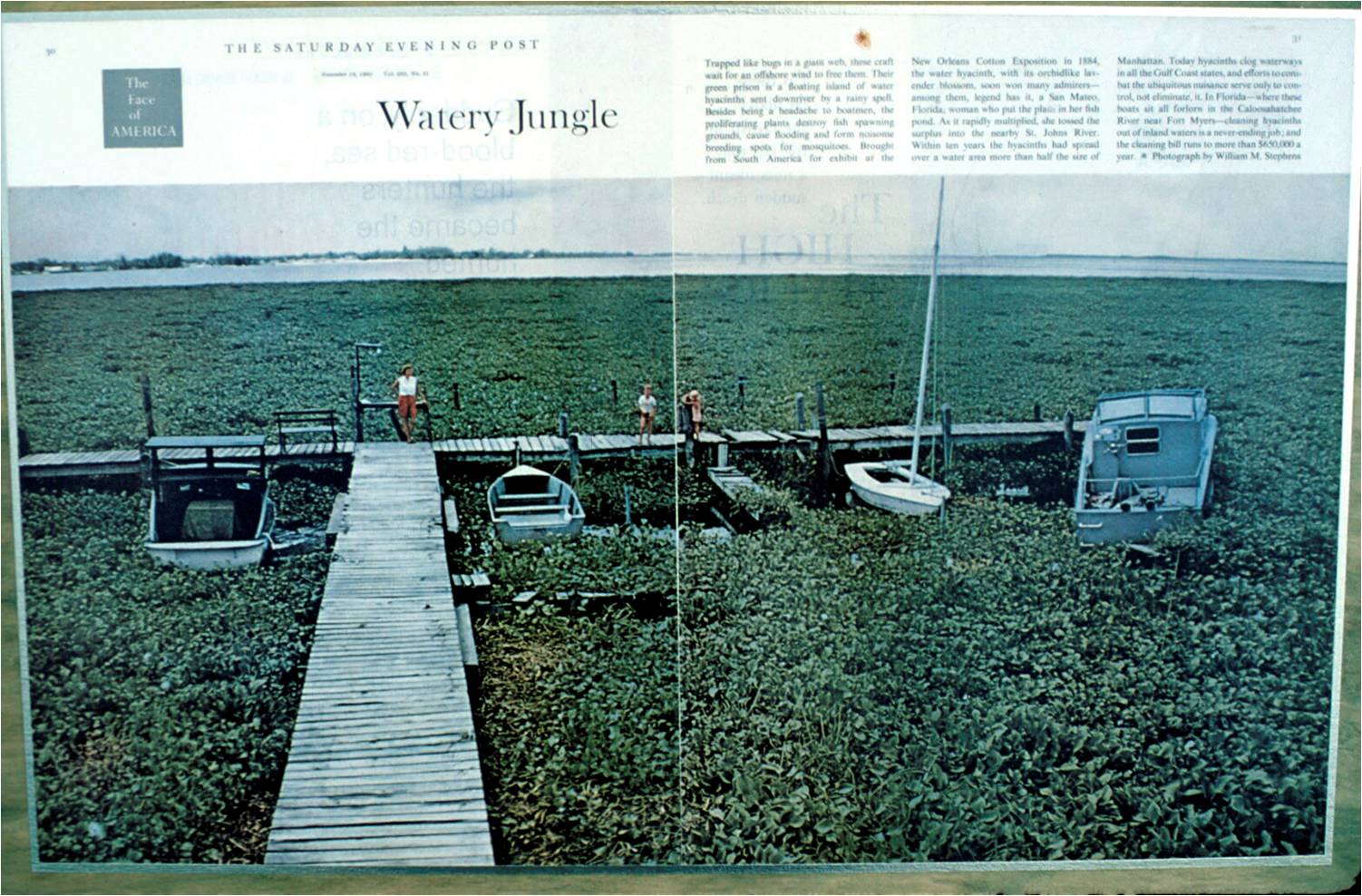
 Water hyacinths infesting the Caloosahatchee River viewed from the south bank in the vicinity of what is now the Tarpon Street Pier in Ft. Myers in 1960 can be seen on the picture below. Recognizing that something must be done to combat this nonindigenous aquatic plant species, the Lee County Hyacinth Control District was formed by an act of Florida Legislation on June 12, 1961. The District’s ongoing maintenance control program on the Caloosahatchee River has been successful at preventing the massive build up of water hyacinths as seen in these pictures from the past.
 LCHCD Historical News
Lee County Hyacinth Control District (LCHCD) has been in the news since its creation and through all the innovations, and improvements on the techniques, and procedures for fighting aquatic weeds. Below is a summary of these news articles.
News from the 1960s
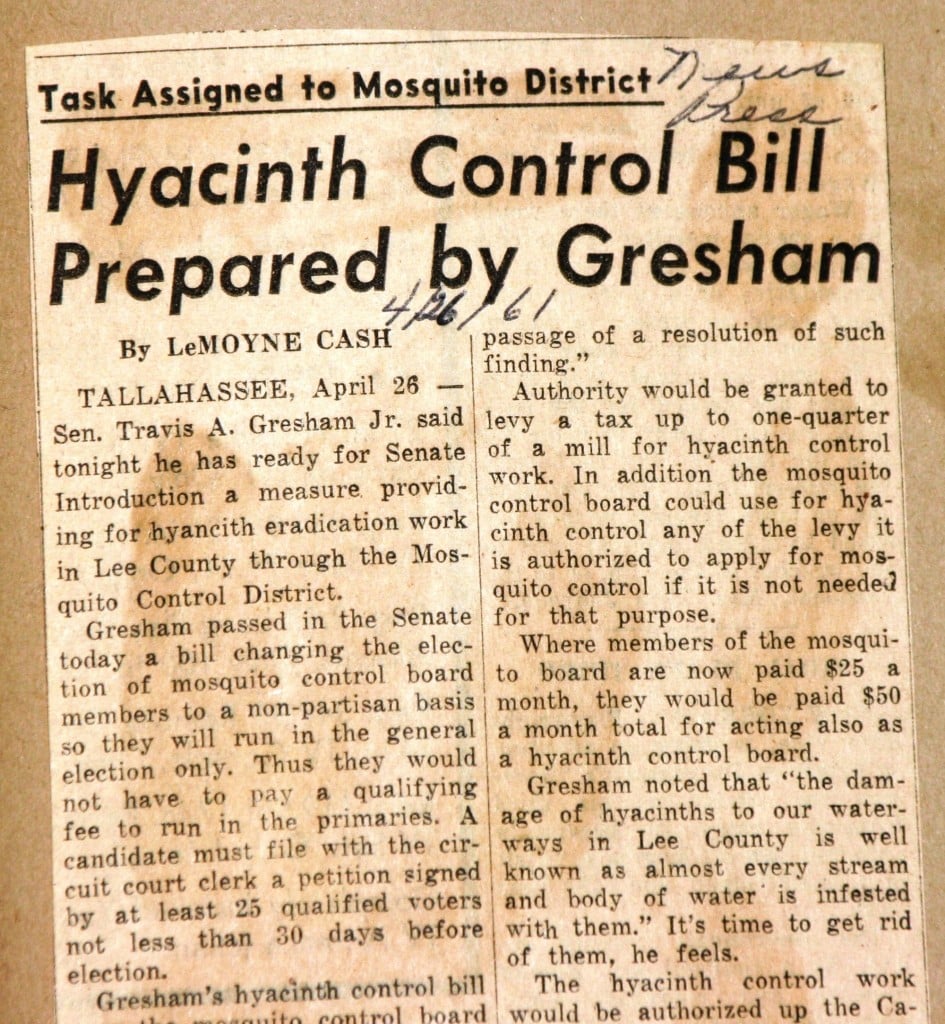
The article below is from the News Press agency, dated April 26, 1961. It is about Hyacinth Control bill prepared by Sen. Travis A. Gresham Jr. and passed in the senate for the creation of the Hyacinth Control District. The article was written by LeMOYNE CASH.
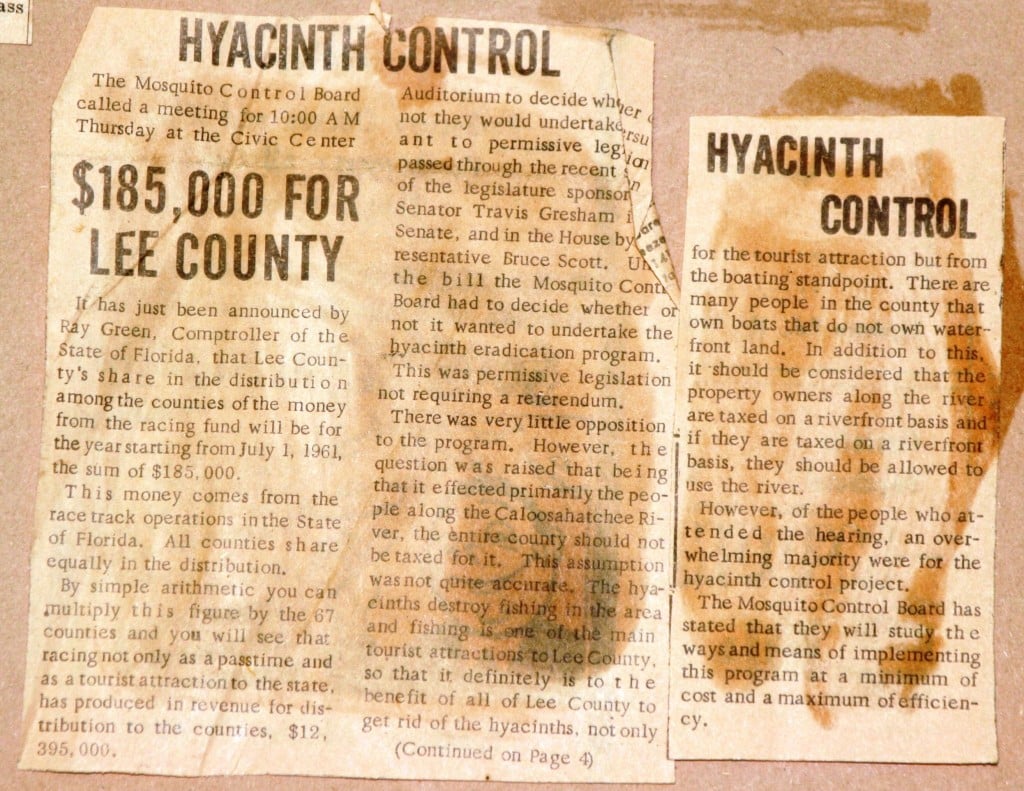
 The article shown below its about Lee County Hyacinth Control receiving the sum of $185, 000 from the States racetrack fund, to help combat water hyacinth in Lee County. The date July 1, 1961, is mentioned as the starting one for receiving the money.
 The article below is from The Tampa Tribune, dated June 16, 1961. It announces the start of Lee County Hyacinth Control Program on October the first. The article was written by Phyllis Dutrow.
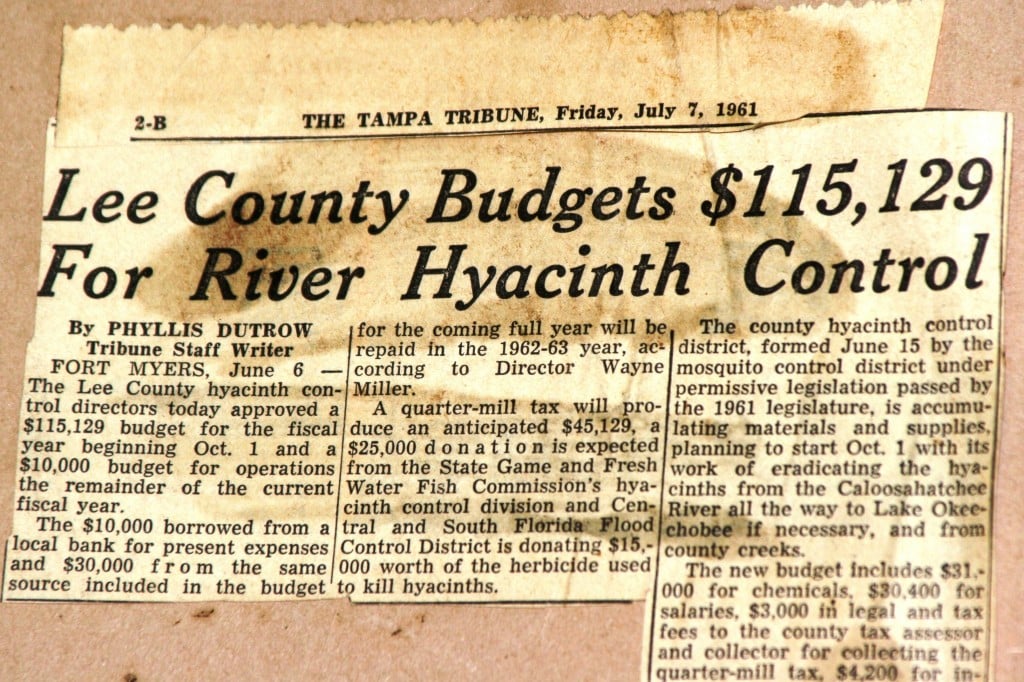
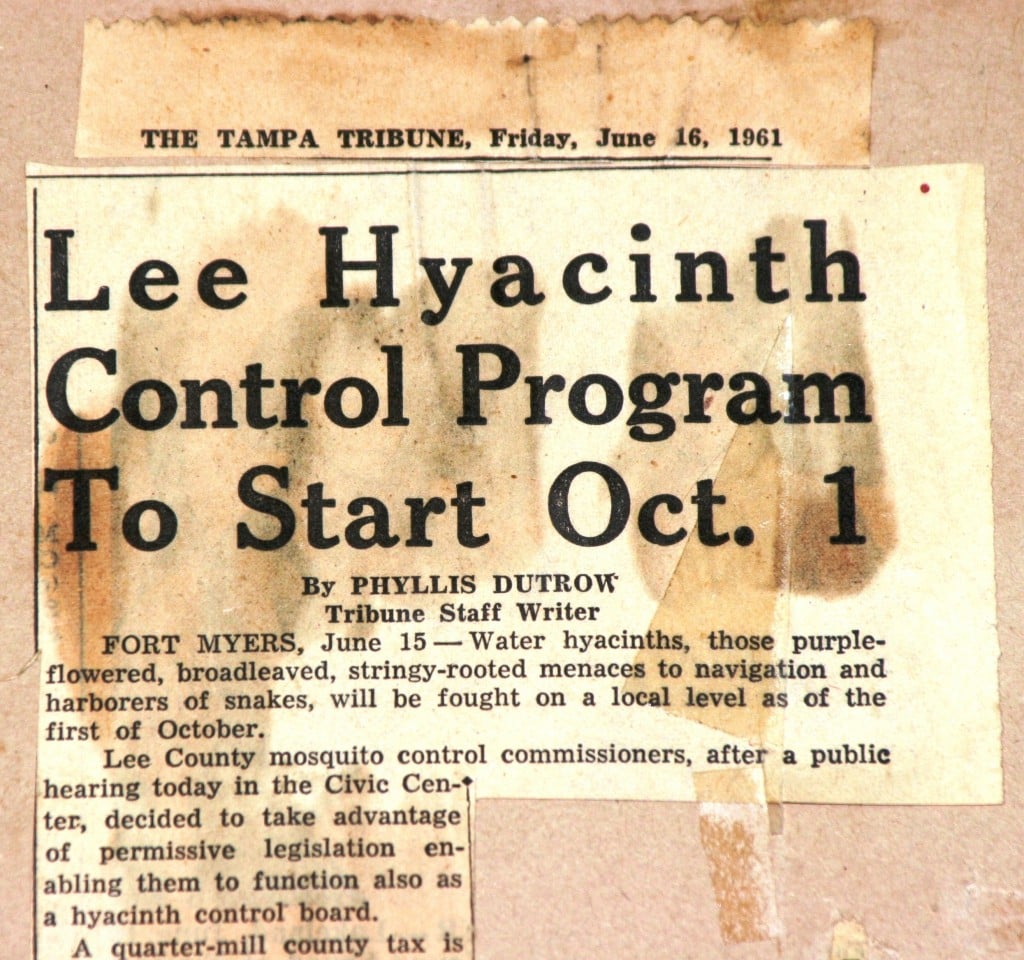 The article below is from The Tampa Tribune, dated Friday June 16, 1961. It is about Lee County budgeting $115, 129 for river hyacinth control. The article was written by Phyllis Dutrow.
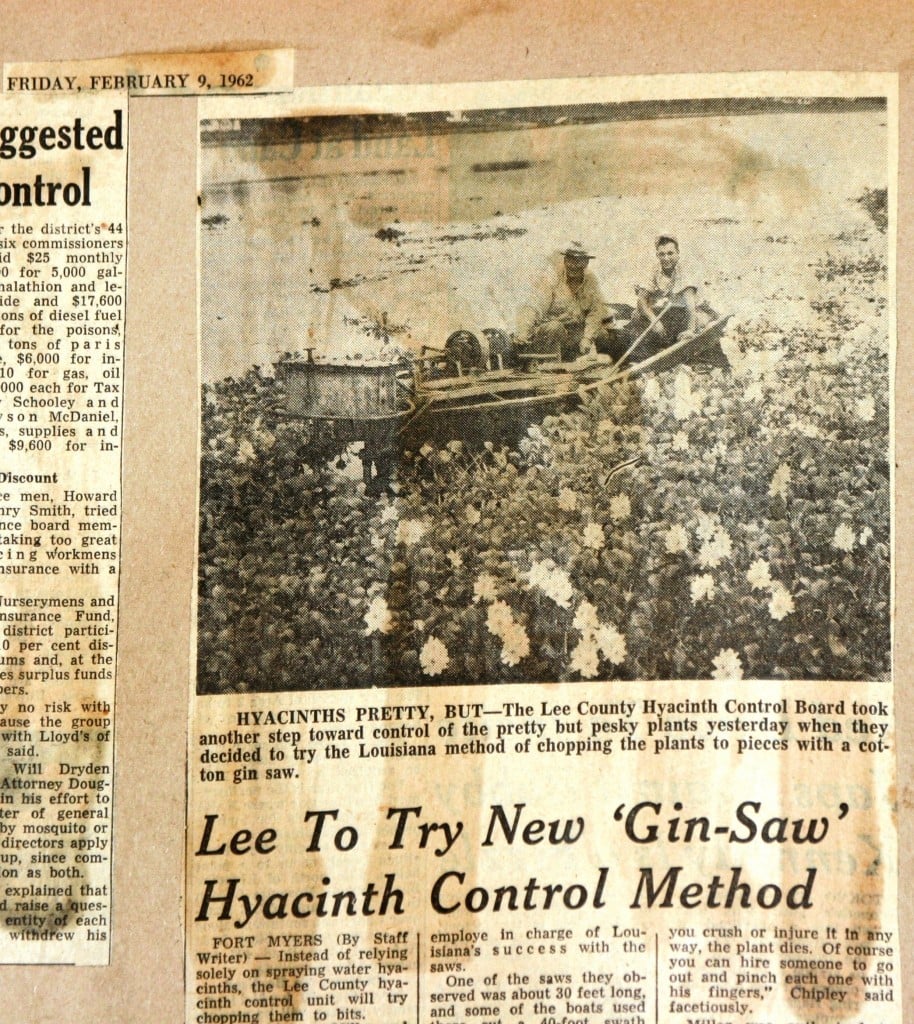
 The article below is dated Friday, February 9, 1962. It is about a new “Gin-Saw” hyacinth control method, consisting on chopping the plants to pieces with a cotton gin saw.
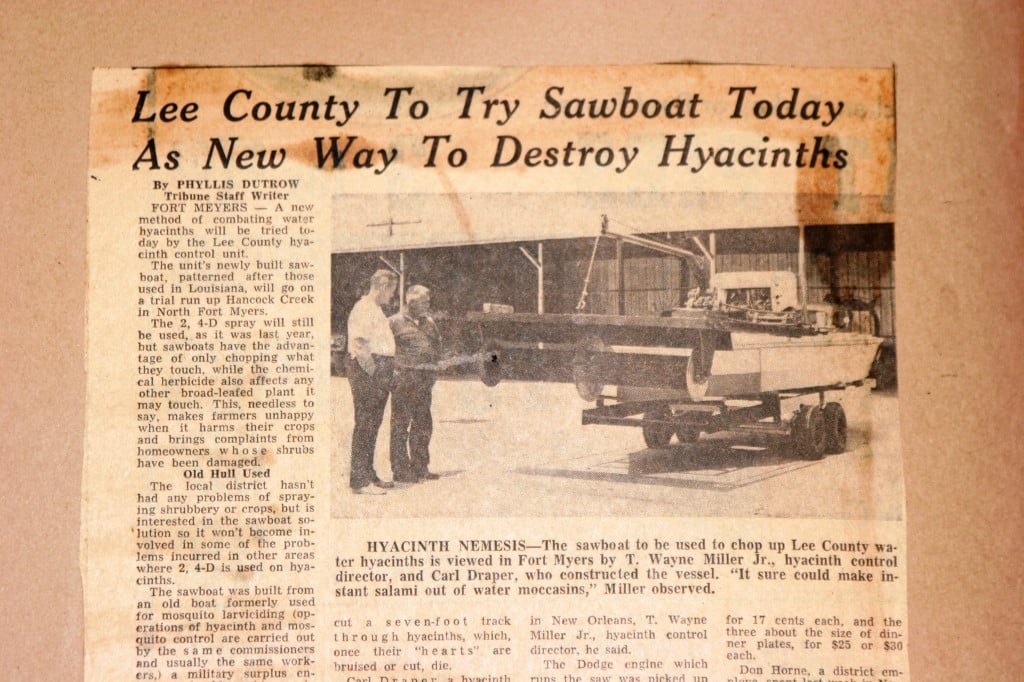
 The article below is from The Tampa Tribune. It is about Lee County trying a Sawboat as new way to destroy Hyacinths. The sawboat to be used to chop up the water hyacinth is viewed by T. Wayne Miller JR, hyacinth control director, and Carl Draper, who constructed the vessel. “It sure could make instant salami out of water moccasins” Miller observed.
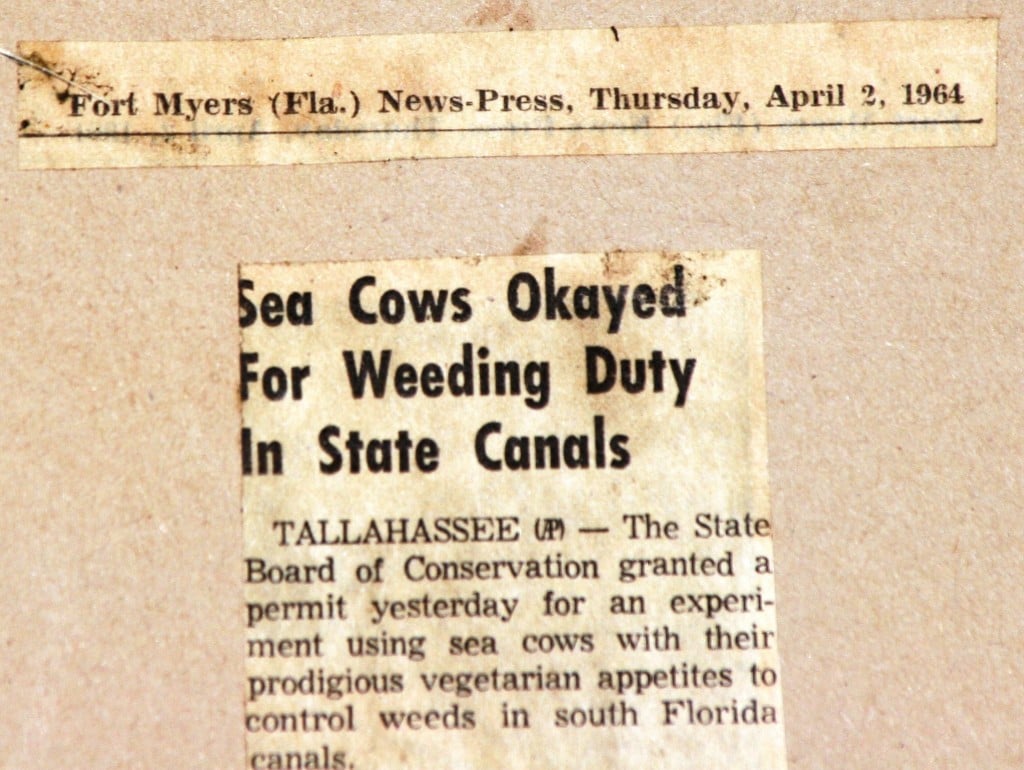
 The article below is from Fort Myers New-Press, dated Thursday, April 2, 1964. It is about the State Board of Conservation approving a permit for using sea cows to control weeds in south Florida canals.
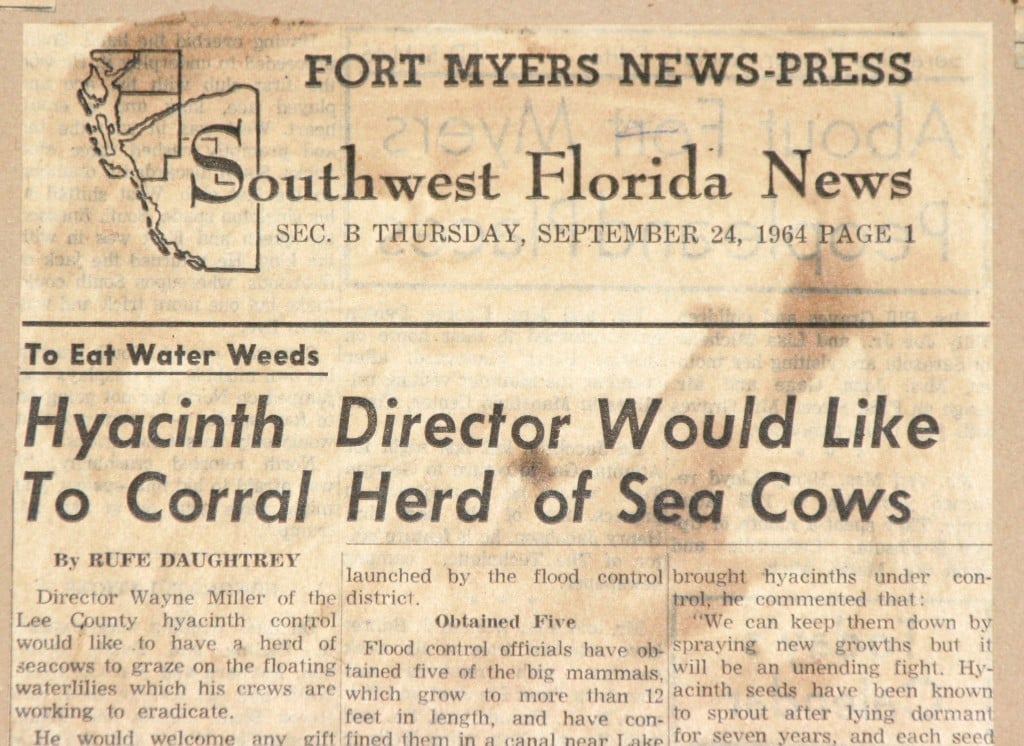
 The article below is from Fort Myers New-Press, dated Thursday, September, 24, 1964. It is about Hyacinth Director wanting to corral herd of sea cow, to graze on the floating waterlilies which his crews are working to eradicate. The article was written by Rufe Daughtrey.
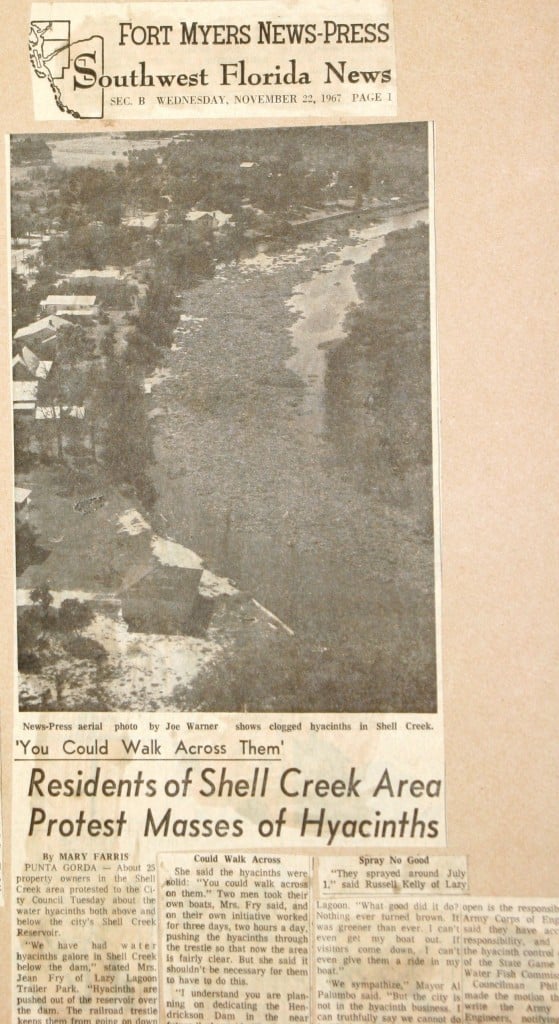
 The article below is from Fort Myers New-Press, dated Wednesday, November, 22, 1967. It is about Residents of Shell Creek protesting about masses of hyacinths. “You Could walk across them” they say.
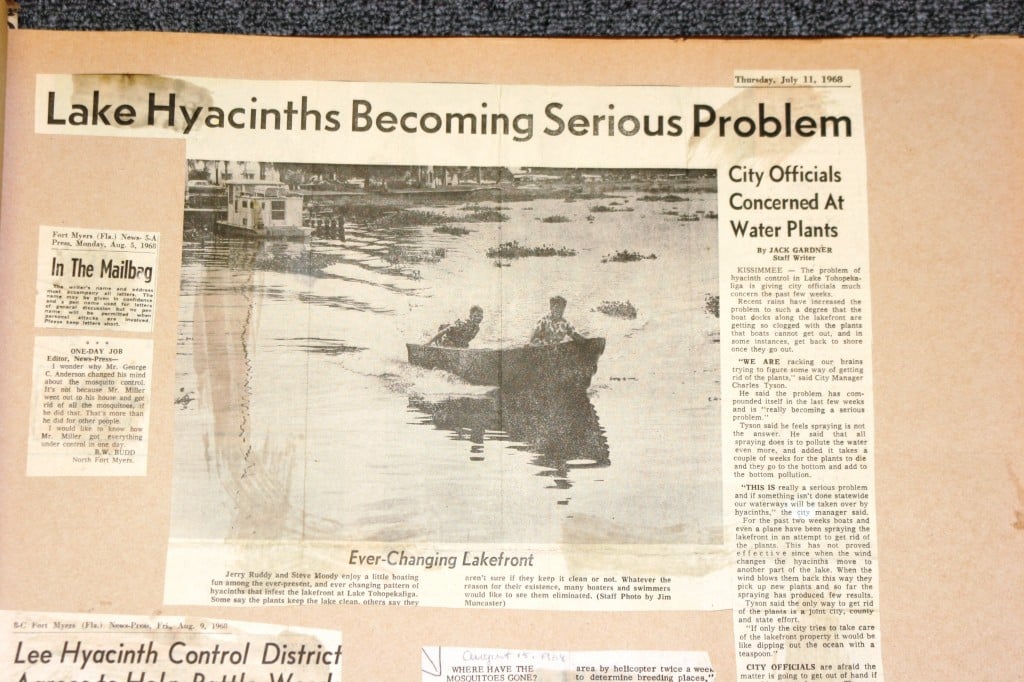
 The article below is dated Thursday, July 1, 1968. It is about lake hyacinths becoming a serious problem by clogging docks and making navigation difficult. The article was written by Jack Gardner.
 News from the 1970s
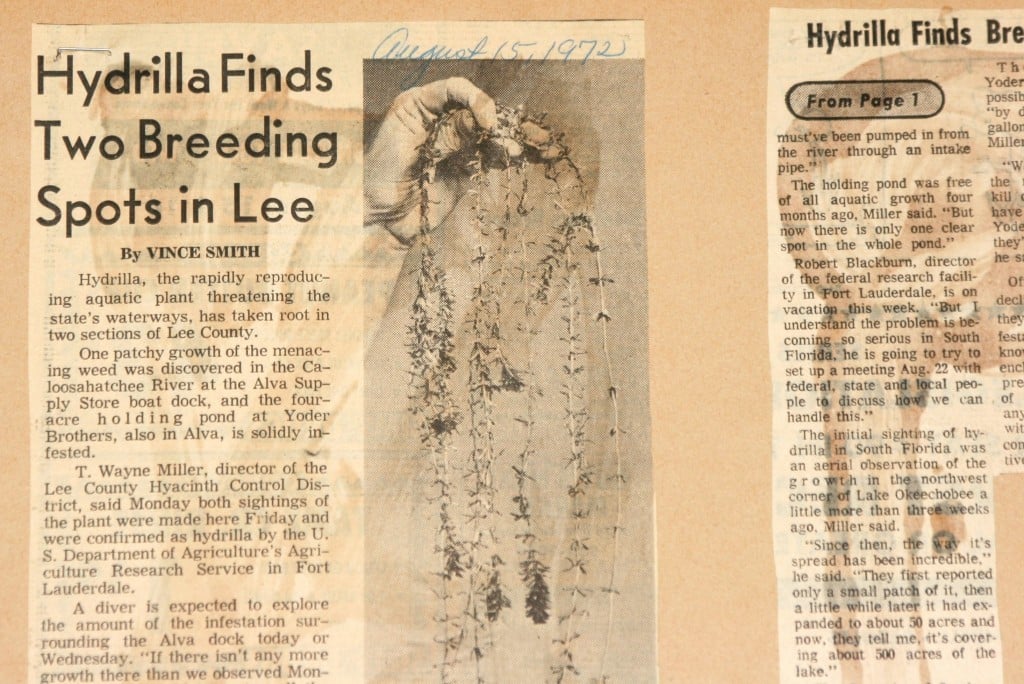
The article below is dated August 15, 1972. It is about the discovering of two Hydrilla breeding spots. One is on the Caloosahatchee River at the Alva Suply Store boat dock and the other one is the four acres holding pond at Yoder Brothers, also in Alva. The article was written by Vince Smith.
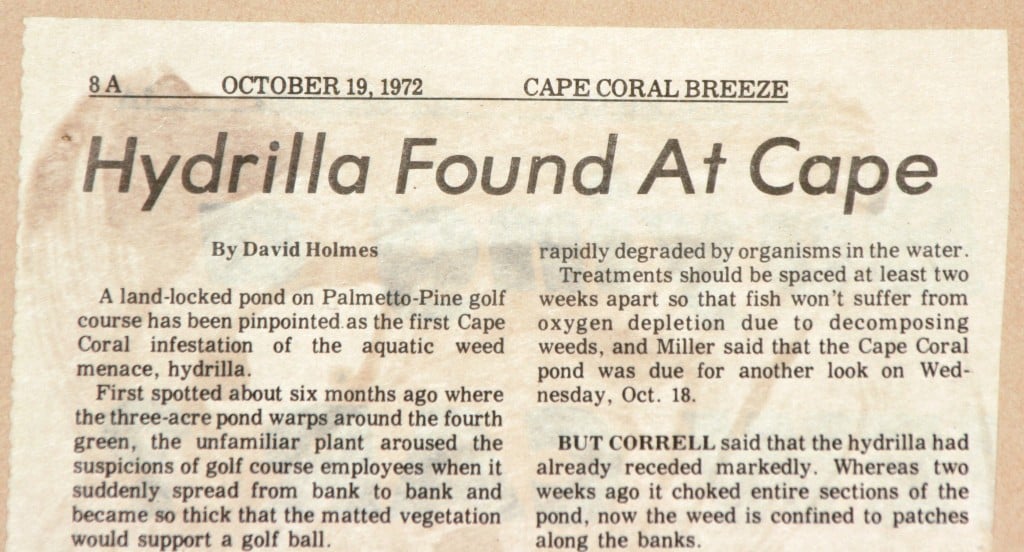
 The article below is from Cape Coral Breeze, dated October 19, 1972. It is about Hydrilla recently found in Cape Coral. The article was written by David Smith.
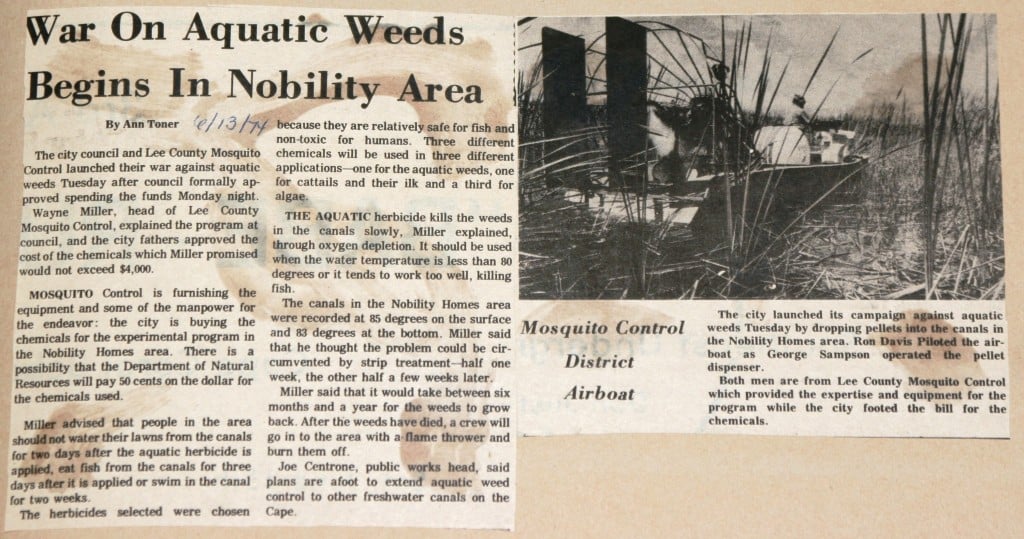
 The article below is dated June 13, 1974. It is about a war on aquatics weed on the Nobility area and how the crews are preparing for the fight. It shows an image of a mosquito control airboat and explains the herbicides used and the cautions the people has to take regarding swiming and eating the fish from the canals. The article was written by Ann Toner.
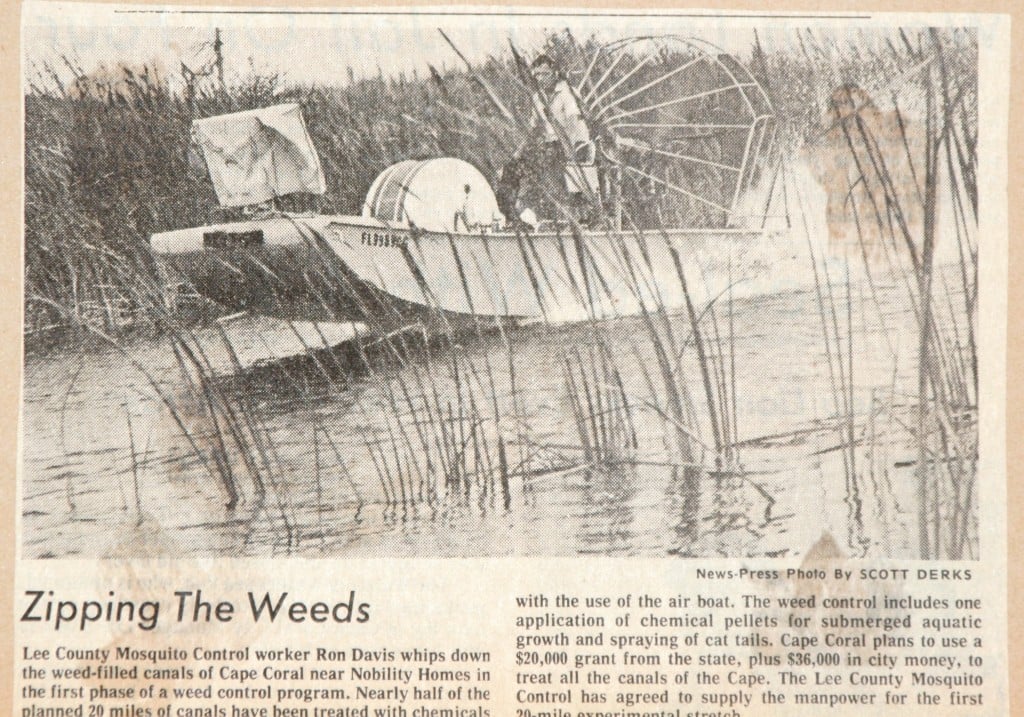
 The article below is from the New Press. It is about how the worker of Mosquito Control Ron Davis whips down the weed-filled canals of Cape Coral near Nobility Homes. It also explains that a submerged treatment with pellets has been done as well as a spraying one. The article was written by Scott Derks.
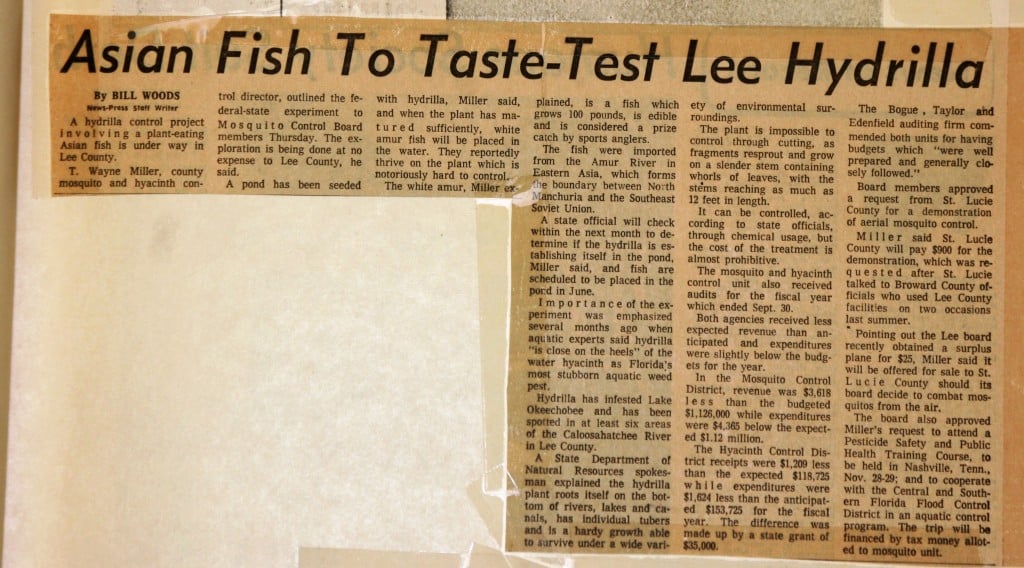
 The article below is from the New Press. It is about a hydrilla control project involving a plant-eating Asian fish. The fish selected is white amur. The article was written by Bill Woods.
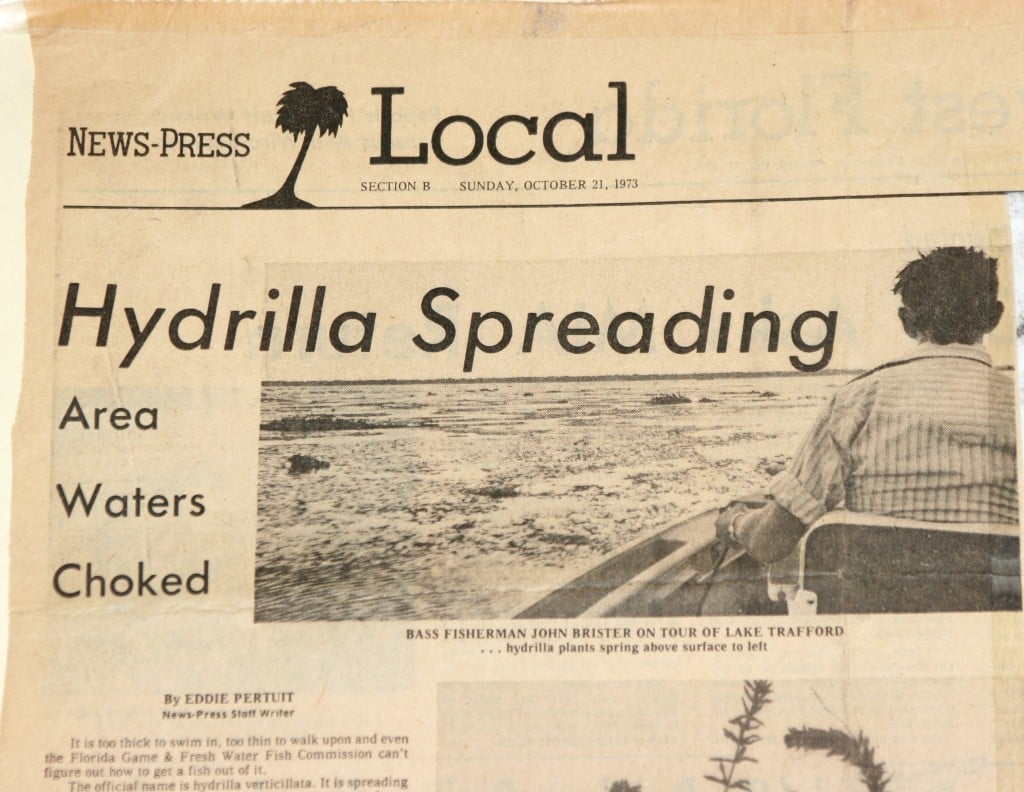
 The article below is from the New Press, dated Sunday, October 21, 1973. It is about Hydrilla spreading choking the waters.The article was written by Eddie Pertuit.
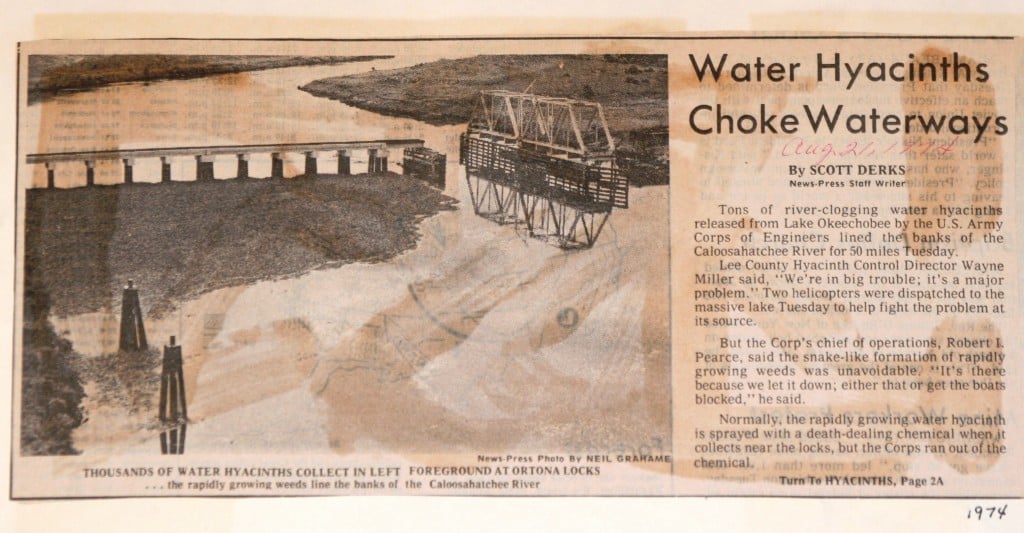
 The article below is from the New Press, dated August 21, 1974. It is about water hyacinth chocking waterways in Lee County and how thousands of water hyacinth were collected in left foreground at Ortona Locks. The article was written by Scott Derks.
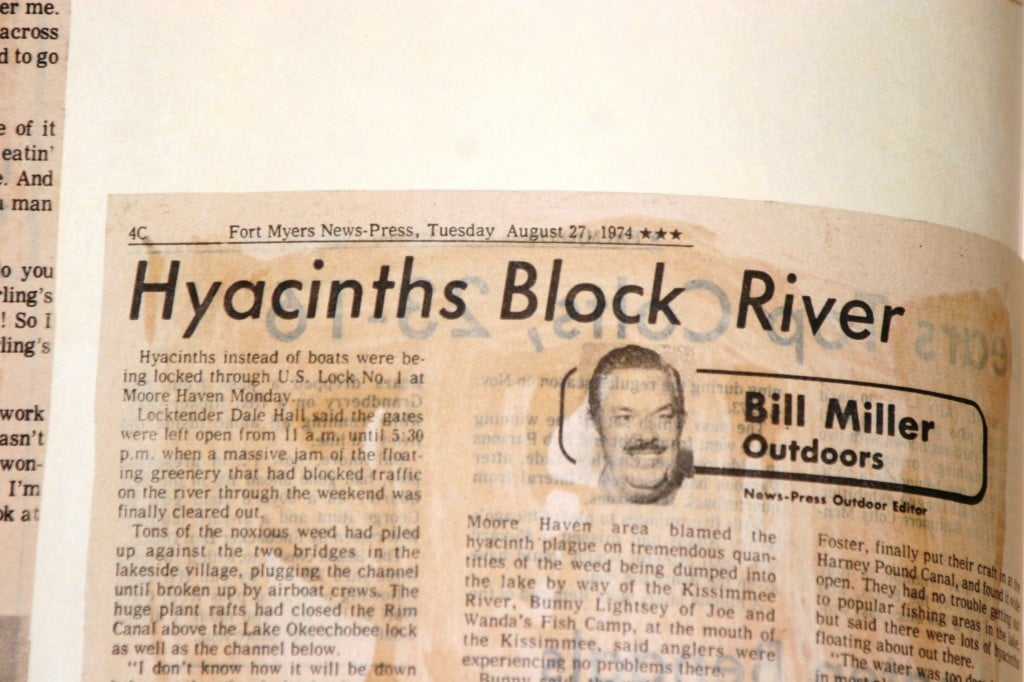
 The article below is from the New Press, dated Tuesday, August 27, 1974. It is about hyacinths blocking the river and how airboat crews had to broke up the weeds. The article was written by Bill Miller.
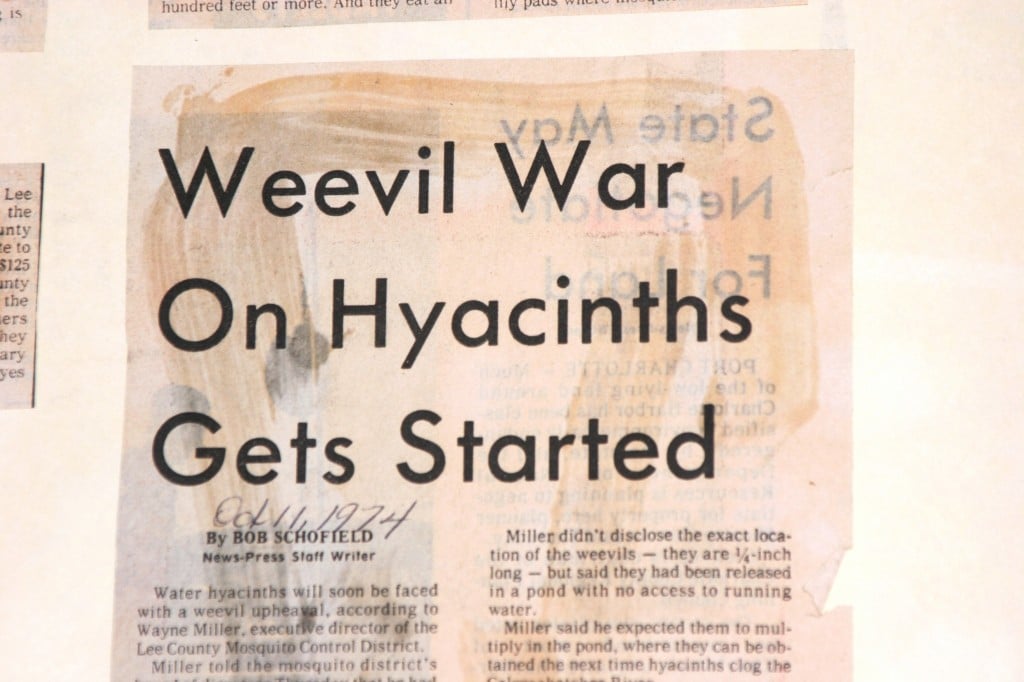
 The article below is from the New Press, dated October 11, 1974. It is about using weevil to combat hyacinths. The article was written by Bob Schofield.
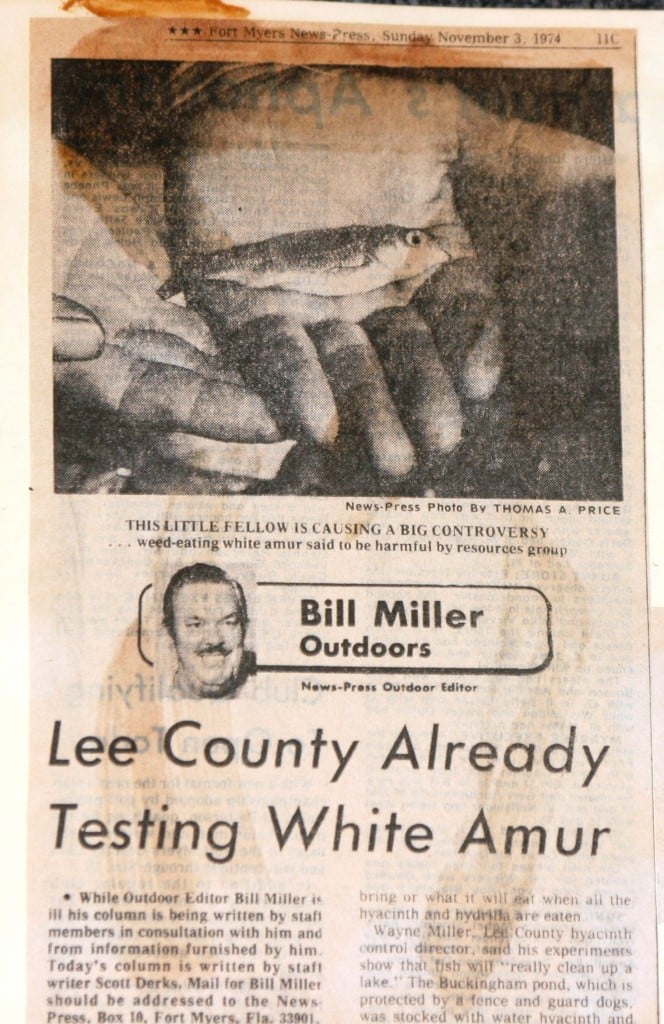
 The article below is from the Fort Myers New Press, dated Sunday November 3, 1974. It is about the use of white amur against the water hyacinths. The The article was written by Bill Miller.
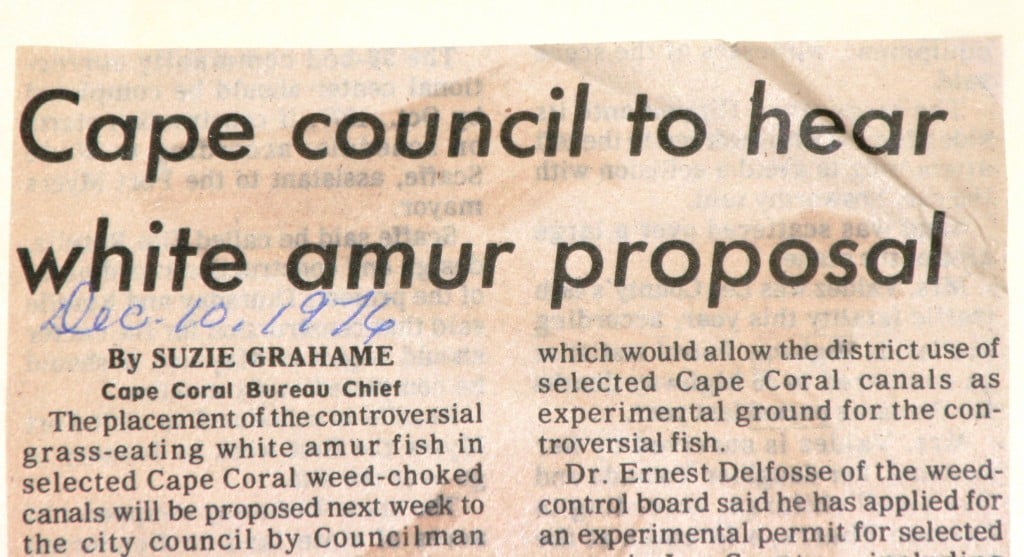
 The article below is dated December 10, 1976. It is about Cape Coral council to hear the withe amur proposal, for using the fish on selected canals as experimental ground. The The article was written by Suzie Grahame.
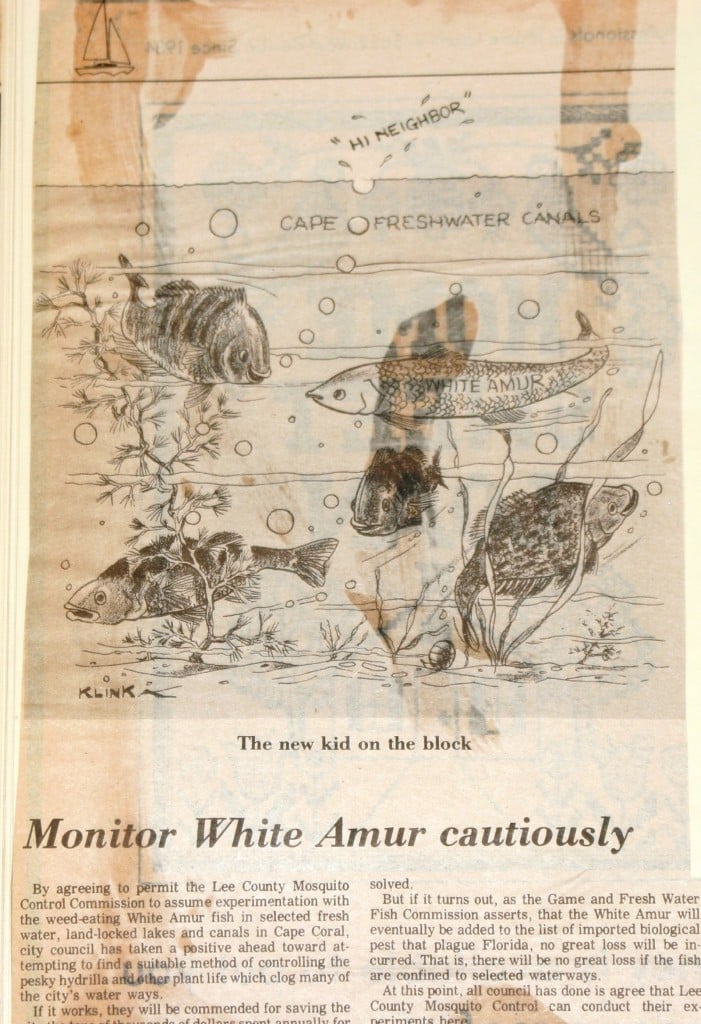
 The article below is about monitoring the white amur cautiously so it not become an imported biological pest.
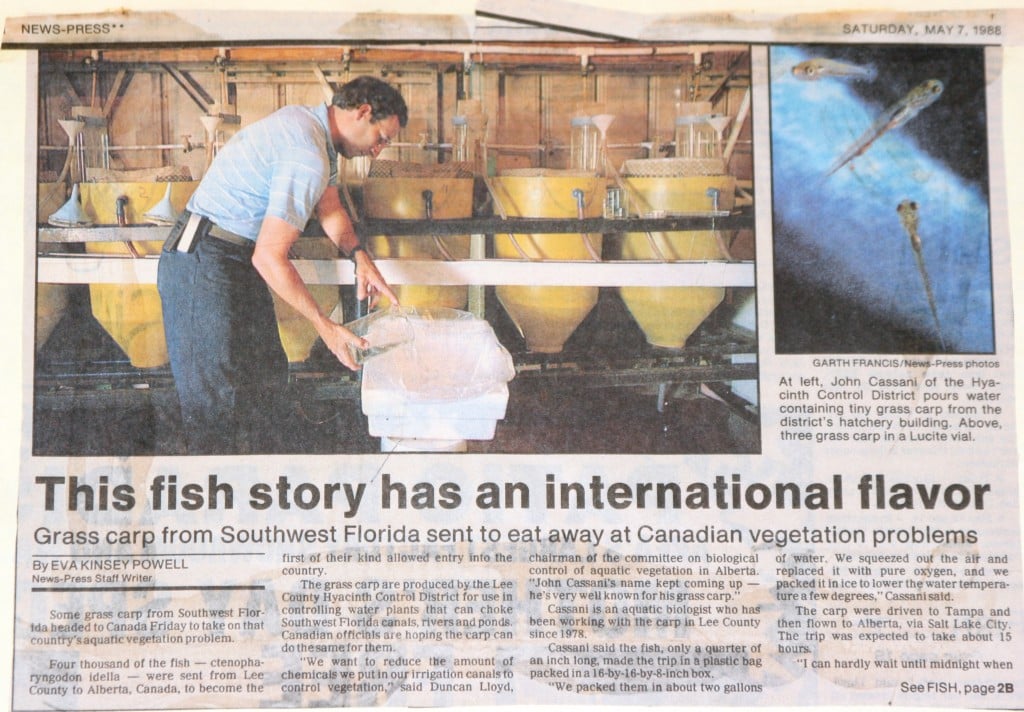
 The article below is from the New Press, dated Saturday, May 7, 1988. It about grass carp from southwest Florida sent to eat away at Canadian vegetation problems. The The article was written by Eva Kinsey Powell.
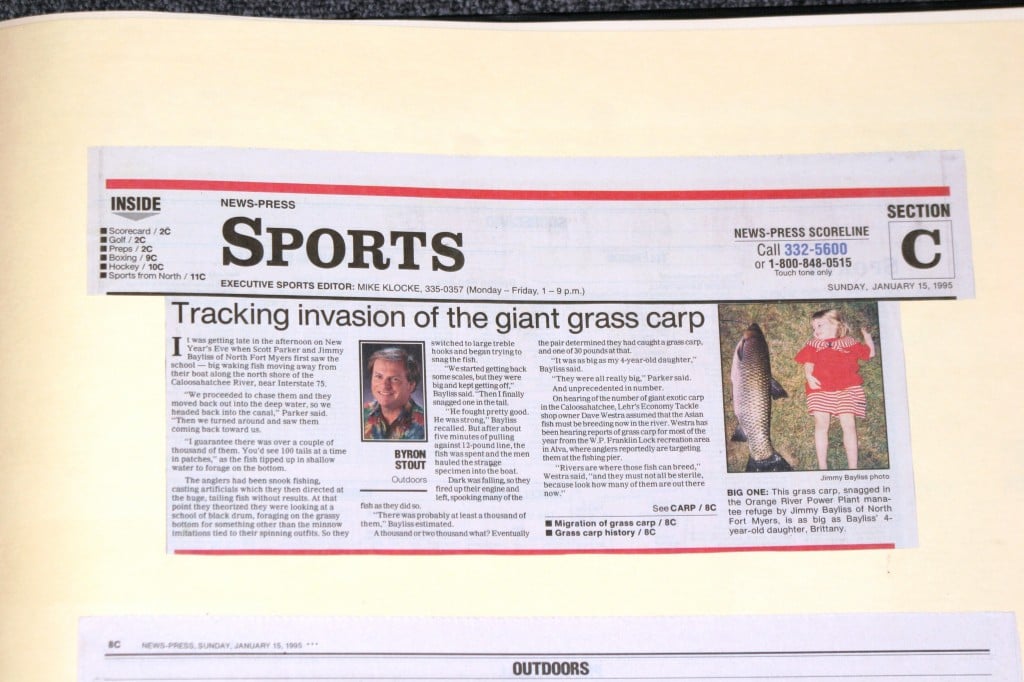
 The next two images below belong to an article from the New Press, dated Sunday, January 15, 1995. It is about tracking invasion of the giant grass carp and how a fisherman caught one about the same size as his 4 year old daughter. Also explains the concerns about the grass carps affecting other animal habitats on the southwest florida principal waterways.
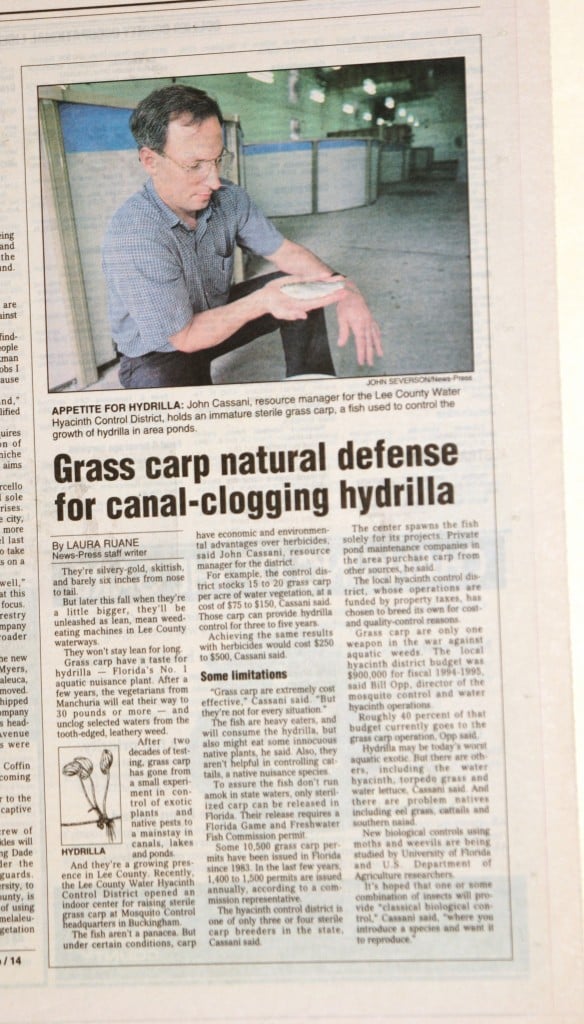
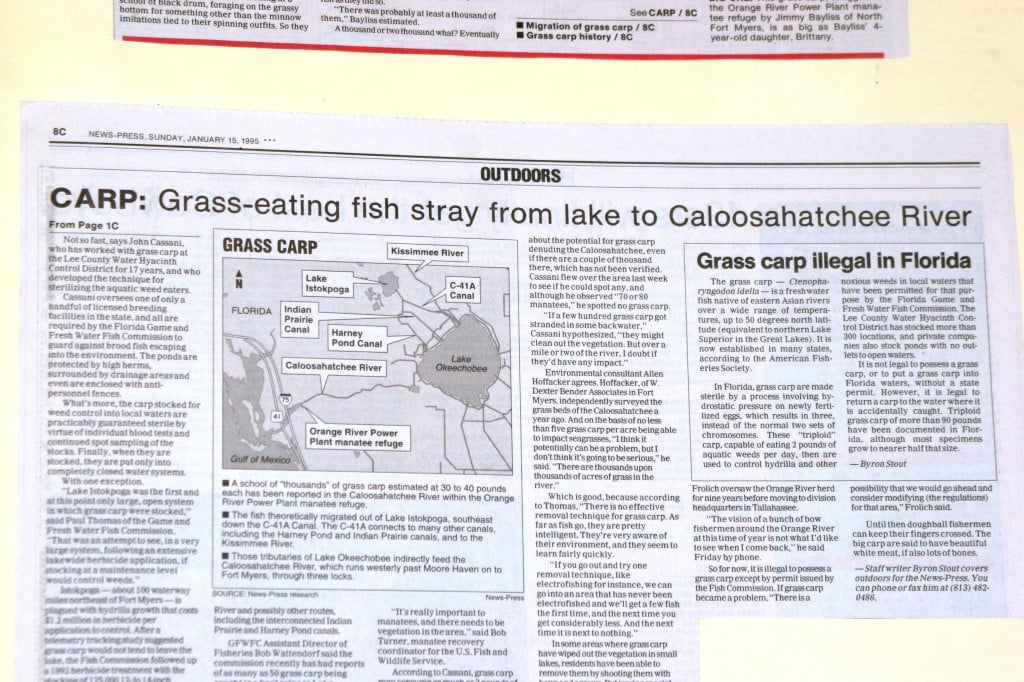 The article below is from the New Press. It is about the use of grass carp as natural defense for canal-cloging hydrilla. It also explains the advantages and limitations of the use of this weed-eating fish. The article was written by Laura Ruane.
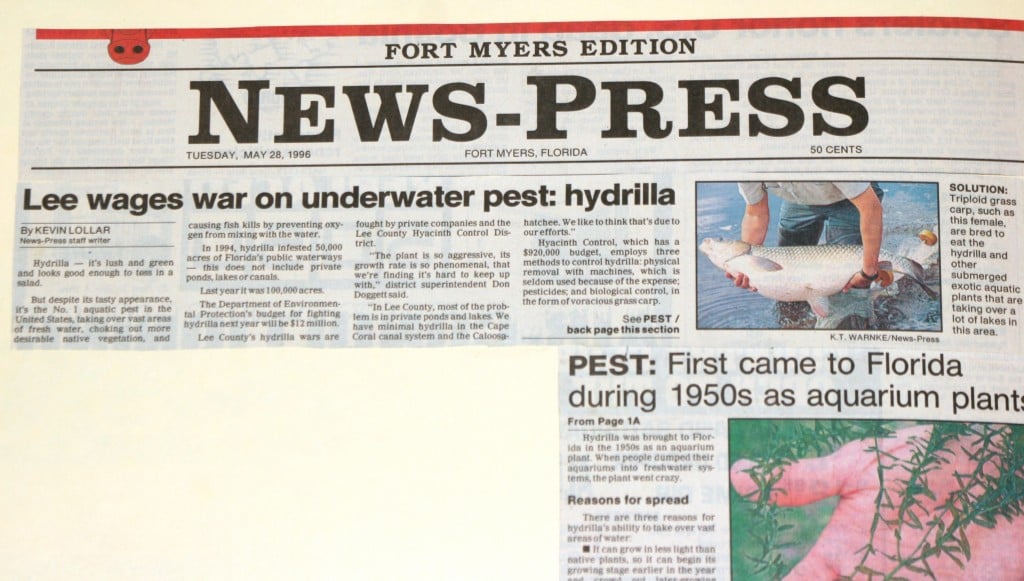
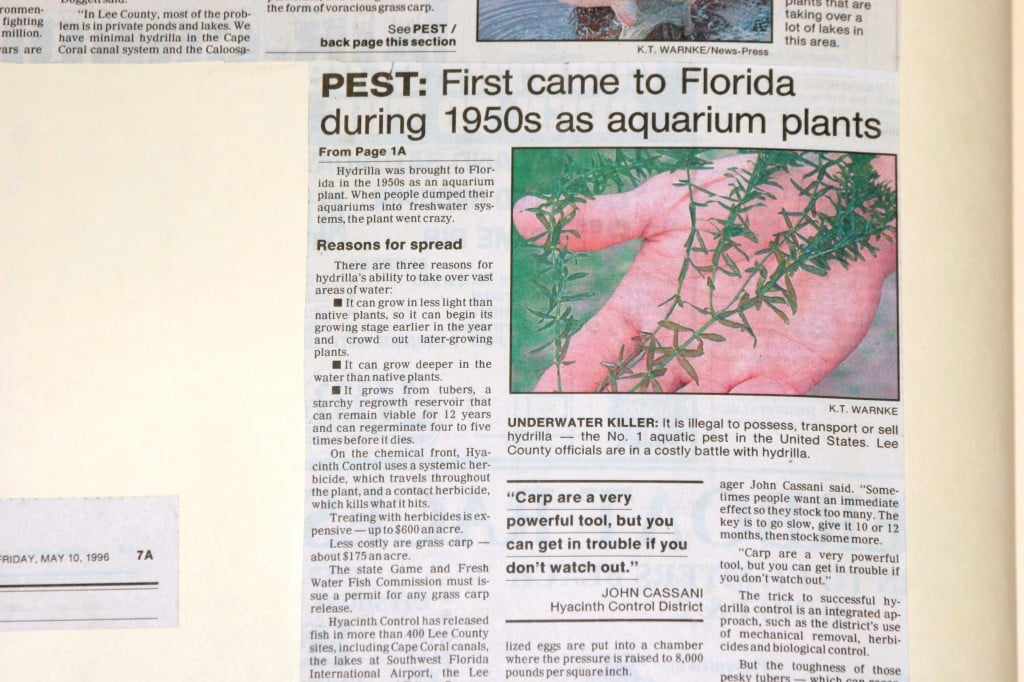
 The next two images below belong to an article from the New Press, dated Tuesday, May 28, 1996. It is about Lee wages war against Hydrilla. It explains how the Hydrilla first came to Florida as an aquarium plant, how fast it spreads and how the use grass carp and other techniques to control it. The article was written by Kevin Lollar.
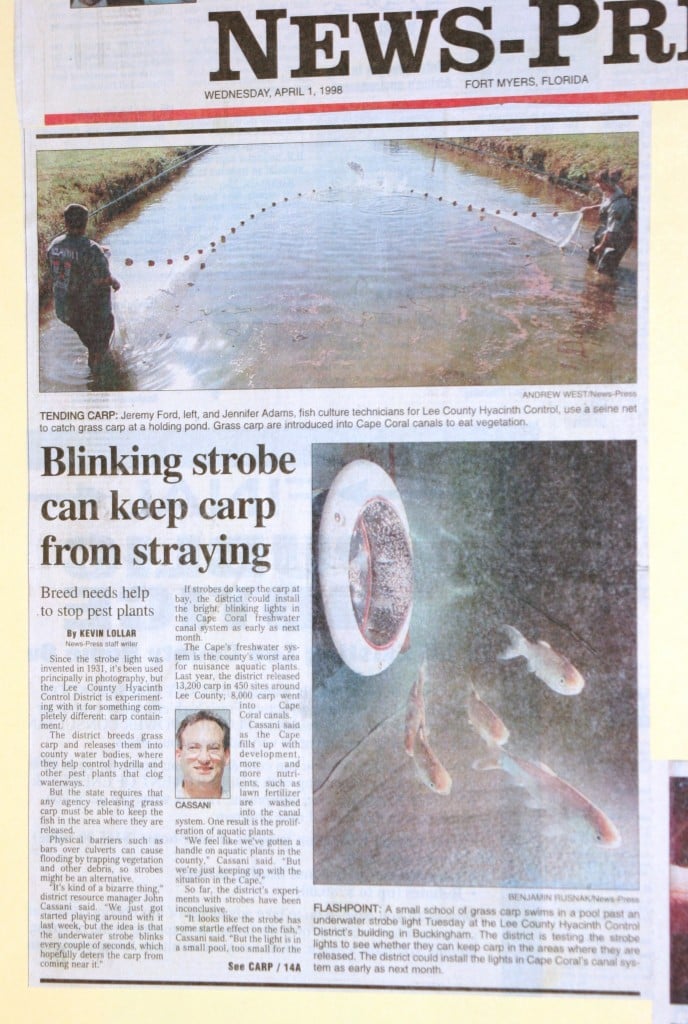
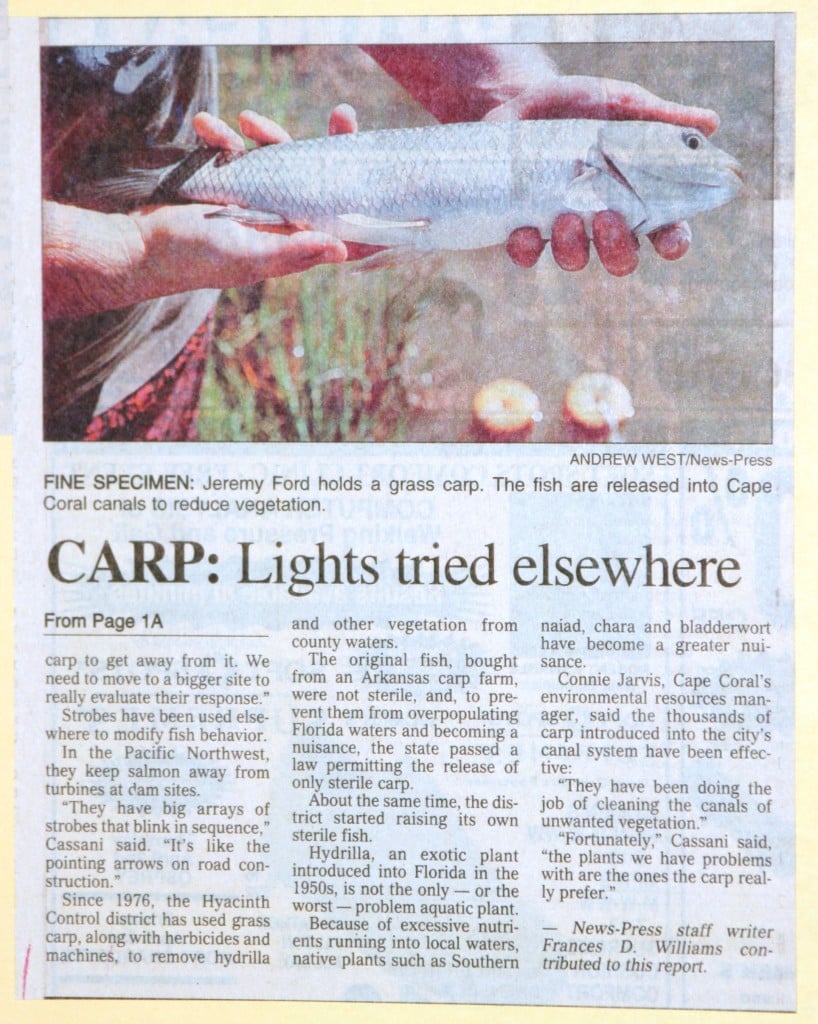
 The next two images below belong to an article from the New Press, dated Wednesday, April 1, 1998. It about the use of blinking strobe for keep carp from straying. It explains that they have planed using the blinking strobe underwater to keep the fishes in the area where they were released. The article was written by Kevin Lollar.